
The Mind-Body Loop: Why Physiology Is Inseparable From Therapy and Mental Health
Written by Joe Nord, LMHC
Cesar Millan built a career on three words: exercise, discipline, affection. Dogs need all three, in that order, or the mismatch shows up in their behavior. It's tempting to file that as a dog problem. It isn't. We need a body that gets to move, a mind that has some structure, and a part of us that feels cared for and connected to other people. Skip one of the three for long enough and behavior tells on us just as faithfully. Exercise alone has real, measured mental health effects: a large-scale analysis of nearly 80,000 participants found it meaningfully reduced both depression and anxiety, with effects in some studies landing in the same range as medication or psychotherapy. That's not an argument for skipping therapy. It's the same argument as everything below: the body isn't a side note to the mental health conversation. It's part of it.
Here's a quick gut check: would you expect to feel more anxious with a resting heart rate of 70, or 40? Lifestyle factors like stress and alcohol tend to push that number up. Walking, exercise, meditation, and quality sleep tend to bring it back down. A number changes, and how on edge or how settled someone feels changes right along with it.
There's a stranger version of the same rule at the level of neurochemistry. Losing a fight shifts a lobster's serotonin within minutes, and its posture changes right along with it. Take a hard loss, real or just perceived, and there's a decent chance something similar happens to us under the surface, whether or not it's conscious. The difference is we have more angles to correct it than a lobster does, from exercise and sunlight on the physical side to reframing the story of what the loss means on the cognitive side. Mice tell a related story: those given free choice to run on a wheel get real physiological benefits, while mice forced to run the same distance mostly just get stressed. Same activity, opposite outcome, because of agency. When something feels chosen, we tend to get something out of it. Forced or imposed before we've made it our own, it starts to feel oppressive, and the body responds to that difference whether we notice it or not.
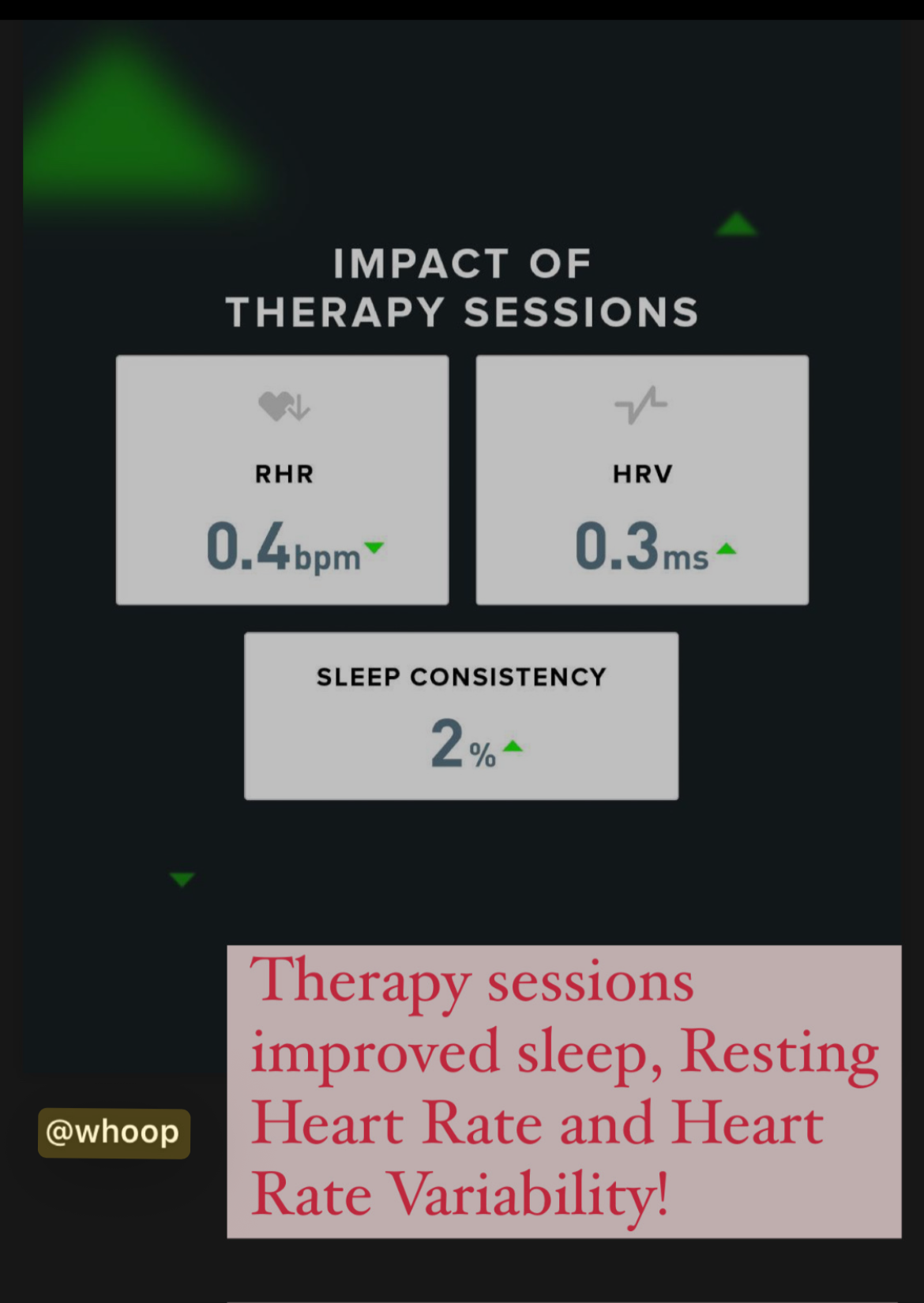
A WHOOP recap of my own data: therapy sessions correlated with lower resting heart rate, higher HRV, and more consistent sleep. The body registers psychological work as clearly as it registers a bad night or a hard workout.
None of this is really about lobsters or mice. It's about how little say we get over our own biology once a choice has been made that affects it. Biometric data, the kind a WHOOP or Oura Ring hands back every morning, is just this same evidence, made personal. It doesn't have an opinion about whether you should have to deal with sleep, alcohol, screens, or anything else. It just confirms that you do.
Acknowledging what physiology does to us, and taking responsibility for the choices that shape it, isn't a small thing psychologically. It's a mature move, the same kind of move as accepting any other fact about reality that doesn't ask for our permission first. Paying attention to the body stops being separate from the work of therapy and starts becoming additive to it, sharpening the psychological work rather than competing with it, and that idea runs through everything below.
The Body You Actually Have
There's a version of well-being that gets sold as purely a matter of mindset. Think the right thoughts, manage your emotions, and the rest follows. It's not true, and most people know it's not true the moment they've gone three nights without real sleep or spent a week hungover and exhausted.
A real, sustainable sense of feeling good day to day can't be separated from what the body needs, and that includes accepting the physiological hand each person has been dealt, whether that's age, an old injury, a chronic condition, or just a season of life that's harder on the body than others.
The Mature Move: Accepting What You Can't Opt Out Of
This is where a piece of old wisdom is worth borrowing. Scott Peck opened a well-known self-help book with the simple observation that life is difficult, and that accepting this fully, rather than resisting it, is what makes it easier to bear. Buddhist thought carries a similar idea, that suffering is a basic feature of being alive, not a malfunction. Neither is a call to give up. It's closer to relief. The goal was never zero difficulty, and it was never a body that feels perfect all the time either.
People living with chronic pain or chronic illness, often nowhere close to feeling 100 percent, still build meaningful lives. They still have good days. They still respond to hard moments with real grace. That's proof the goal was never a body without limitation. It's proof that the mature move is accepting the connection between brain and body and working within that reality, rather than expecting the mind to feel motivated, clear, and content while the body's basic needs go unmet.
Where This Loop Shows Up
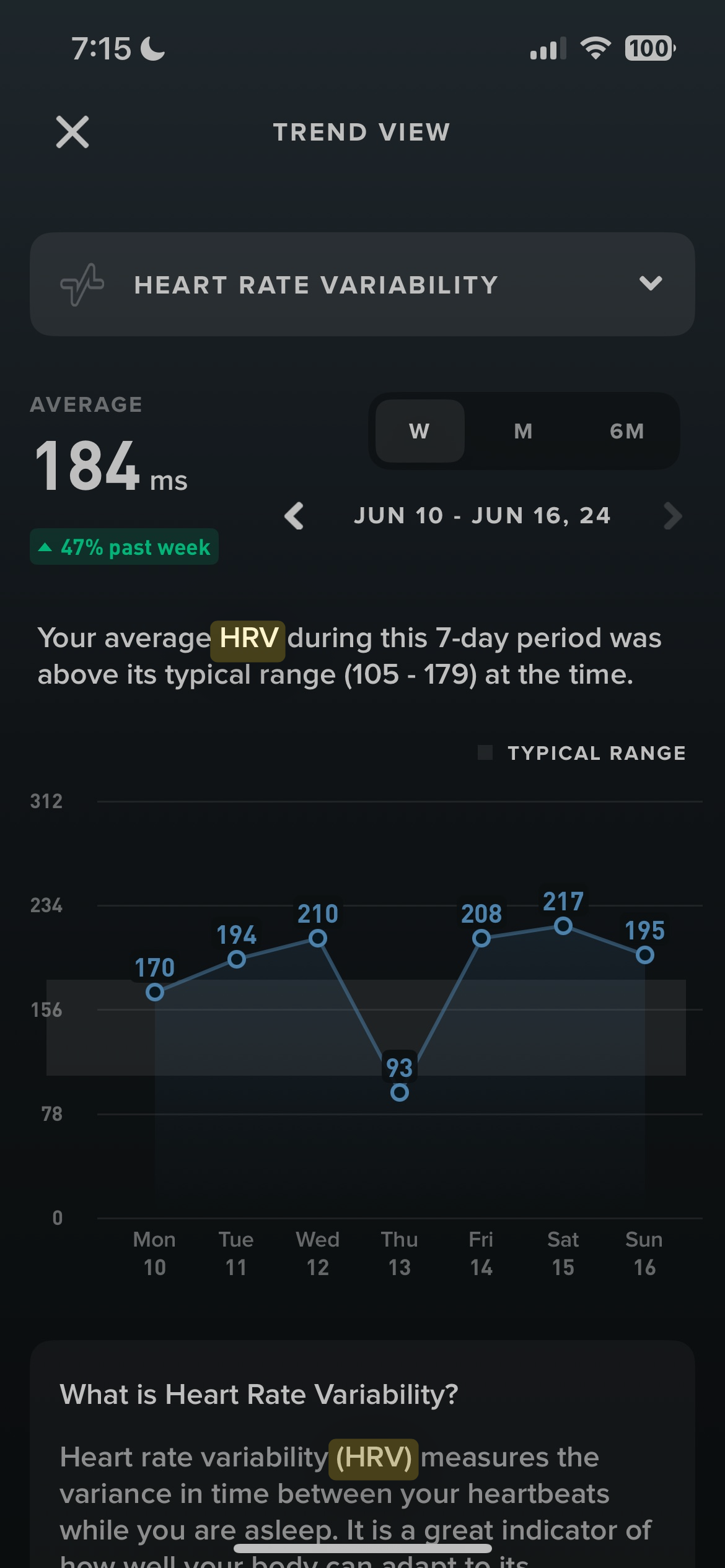
Looking at this graph, it's not hard to guess which day was going to take more effort to feel energized, clear-headed, patient, and present with the people who matter. Biology doesn't decide the outcome, but it sets how much it costs to get there.
I spent years coaching before I became a therapist, and I watched this play out constantly, long before it had any clinical meaning to me. Athletes carrying stress they hadn't named out loud, and their bodies telling on them anyway. Once we started tracking recovery data, that gap between what someone said about their state and what their body actually showed became visible in a way it never had before.
Heart rate variability, or HRV, was usually the clearest signal. It reflects how much load the nervous system is under, and it doesn't care whether someone is willing to admit they're stressed. A hard week, whether from training, a relationship conflict, or something as ordinary as final exams for a college student, would show up the next morning in a lower HRV and a higher resting heart rate, whether or not the person felt like they were handling it fine.
None of this means biology decides the outcome of a day. It means it sets the cost of getting there. On a low-HRV morning, staying patient, present, and clear-headed is still possible. It just takes more presence and effort out of a person to do it. Enough days like that in a row, and the gap between what someone's capable of and what it costs them to access it starts to add up, which is usually when performance, mood, or relationships start to show the strain.
That's the bidirectional part. Stress and emotion shape the body's physiology. But the reverse is just as true. A depleted nervous system feeds back into mood, patience, and clarity of thought. It's not two separate systems taking turns. It's one loop.
What Do WHOOP and Oura Ring Actually Teach You About Mental Health?
This is where consumer biometric tracking earns its keep. Devices like WHOOP or an Oura Ring aren't clinical tools, and using one isn't a substitute for actual biofeedback therapy. What they are is an accessible way for someone to see their own data reflected back at them, tied to their own choices.
Telling someone that poor sleep or drinking affects their mood rarely changes behavior. It's abstract, and easy to file away as advice for someone else. Seeing your own recovery score drop the morning after your own bad night does something different. It stops being a lecture and becomes information about yourself that's harder to argue with.
Can a Blood Panel Explain Your Fatigue, Anxiety, or Low Motivation?
Before assuming any of this is a willpower problem, it's worth ruling out what a basic blood panel can actually show. Chronic indecision, restlessness, fatigue, low motivation, trouble sleeping, a flattened sense of excitement about things that used to matter all of these can have real physiological contributors: thyroid function, vitamin D, B12, iron, testosterone, among others. And it doesn't take years to get there. A hard stretch, a stressful few months, taking some real losses back to back, grinding through a relationship that's been quietly draining for a while- any of that can be enough to shift hormones, neurochemistry, and nutrient levels in ways that outlast the situation itself. I'm not a physician and can't interpret labs, but I regularly encourage clients to bring this up with their doctor before we assume what they're feeling is purely psychological. Sometimes it is. Sometimes it's a number that's been low for a while, quietly making everything else harder than it needs to be.
What TRT and Peptides Are Actually Telling Us
A lot of men right now are turning to TRT, peptides, and other pharmacological tools looking for more drive, sharper focus, and a stronger sense of capability. This isn't a comment for or against any of that, and it's a medical decision that belongs between a person and their physician. But it's worth noticing what it reveals. Men are willing to spend real money and take on real medical intervention chasing a feeling, and many report genuine gains in motivation and sense of self-efficacy when they get it. That's not proof that pharmacology is the answer. It's proof of how tightly physical state and mental state are wired together.
The Same Lever, More Available Entry Points
The good news is that a real shift in energy, motivation, and mood doesn't only come from a prescription. A lot of the same ground can be covered through behavior.
What You Can Do Physically
Lifting weights and other resistance training. Short, intense cardio. Real sunlight exposure, which matters for vitamin D and for circadian rhythm. Actually prioritizing sleep instead of treating it as optional. Cutting back on alcohol, and likely marijuana too, though the evidence there is still developing and probably depends on how often and how much.
The Habits That Are Easy to Excuse
The harder ones to admit are usually the quieter habits. Hours of video games, pornography, or just general screen time late into the night don't feel like they cost anything in the moment, which is exactly why they're easy to write off. But they take up the same recovery windows sleep and downtime are supposed to fill, and the body doesn't distinguish between "I was working too hard" and "I was on my phone until 2 AM." It just registers depletion either way. Believing the usual rules don't apply to you personally is rarely a conscious thought. It's just what it looks like to skip the evidence.
Underneath all of it is working on the anxious and depressive thought patterns that keep the whole system activated in the first place, since burnout and performance anxiety often start here long before anyone would call it that.
Neither Lens Is Enough Alone
Focusing only on biology, optimizing sleep, training, and hormones without ever examining the thoughts and beliefs driving behavior, leaves someone limited, chasing physical fixes for problems that are also psychological. But focusing only on the cognitive and emotional side, treating the body as incidental or something the mind should simply override, is its own kind of avoidance. A refusal to accept that the body is part of the self, and that it requires the same ongoing attention as anything else worth taking care of.
The two work together. Paying attention to physiology gives insight that can inform the psychological work. Psychological work, examining beliefs, patterns, and choices, informs what someone actually does with their body. Neither one replaces the other, and that's really the point. The body isn't a separate concern from the therapy work. It's part of it.
Frequently Asked Questions
Does exercise really help with anxiety and depression? Yes. Large-scale research, including a recent analysis of nearly 80,000 participants, has found that exercise meaningfully reduces symptoms of both depression and anxiety, with effects in some studies comparable to medication or psychotherapy.
What is HRV, and why does it matter for mental health? HRV, or heart rate variability, measures the variation in time between heartbeats and reflects how much load the nervous system is under. A lower HRV often signals accumulated stress, poor sleep, or overtraining, even when someone feels fine on the surface. It's one of the clearest physical signals of the mind-body loop.
Can a WHOOP or Oura Ring actually improve therapy outcomes? They can be a useful complement to therapy. These devices aren't clinical tools and don't replace therapy or formal biofeedback treatment, but they give people concrete, personal data about how sleep, alcohol, and stress affect their body, which can make psychological patterns easier to see and work with in session.
Is this approach only about physical health, or is it actually psychological? It's both, and that's the point. Focusing only on the body without examining thoughts and beliefs leaves someone limited. Focusing only on thoughts and beliefs while ignoring the body's basic needs does too. The most effective approach treats them as one connected system.
Ready to Work on This Together?
I'm Joe Nord, a licensed mental health counselor and owner of Nord Therapy, a private practice built to help people navigate stress, performance anxiety, burnout, and the harder-to-name stuff underneath all of it. My approach draws on REBT, ACT, existential frameworks, and years of coaching experience, treating the body's data as part of the conversation, not separate from it.
I work with clients in New York State, NYC, and Westchester County. If any of this resonated, I'd be glad to talk about possibly working together.